
What is henna? | Learn to henna | Buy henna | Get hennaed
About Holly | Portfolio | Resources | Contact
The Dangers of "Black Henna"
You may have read on various websites about the health dangers of "black henna"... I will once again reiterate the importance of knowing what you're getting and what the risks are.
Please note: not all 'black henna' artists are bad people; the majority don't even realize how unsafe it is! Knowledge is power, and my message will provide you some insight on the risks.
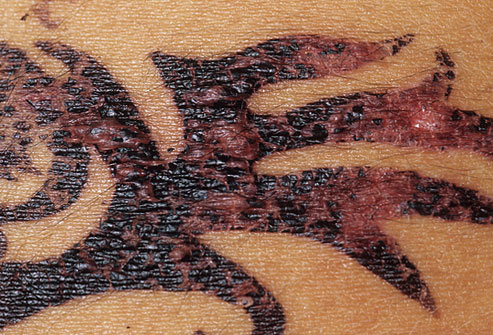
Typical "Black henna" reaction: swelling, itching, blistering, scarring and more.
There is no such thing as black-coloured henna. The jet black colour is achieved from a chemical ingredient added to the paste. This synthetic ingredient is usually a coal-tar dye called "PPD" or para-Phenylendiamine. It is absorbed into your skin, enters your blood stream, and in turn passes through your kidneys and liver. People have had extreme reactions and lifelong damage.
The chemical burn caused by PPD causes the skin to blister, swell and itch. You can have a permanently scar. You can also develop allergies to other things, even if you use it once.
Every single application of "black henna" affects you - the toxins stay in your body for the rest of your life.
Even if you don't see a visible reaction to PPD, it is still harmful. PPD penetrates deep into the skin, reaching the dermis (living cells) and passing into the blood stream. This is in contrast to henna, which only penetrates as far as the dead skin cells of the epidermis. Once in the blood stream, PPD may have effects on the kidneys, resulting in kidney impairment. Repeated or prolonged inhalation exposure may cause asthma, so those who prepare PPD-based black henna are at risk as well. PPD never leaves your body - in fact, it accumulates in your body after each and every exposure to it, leading to permanent injury and sensitivities/allergies.
Imagine not being able to use sunscreen, cosmetics, dark-coloured fabrics, leather, and hair dyes ever again. And that's the best-case scenario.
PPD is regulated by Health Canada for limited use in products, such as hair dyes. It is not intended for use directly on skin, especially in high concentrations.
Health Canada effectively bans the use of "black henna" temporary tattoo ink and paste containing PPD:
Since Health Canada ruled that using PPD in henna, vendors have started using other chemicals: Nigrosene (or Nigrosine, also called "Acid Black 2") is an Azo dye. It has been commonly used in shoe polish, and dying leather and plastic. Nigrosene is also very harmful and can cause similar reactions (blistering, itching, swelling, scars) and allergies, and has been linked to cancer.
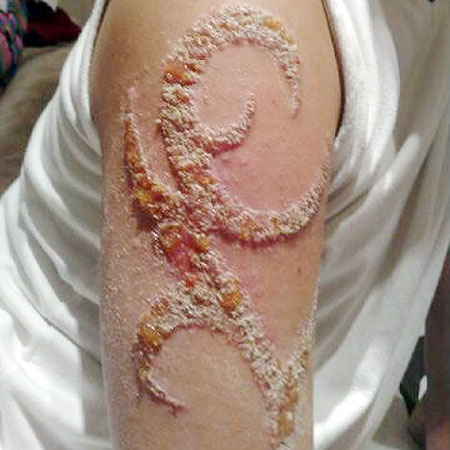
Typical "Black henna" reaction: swelling, itching, blistering, scarring and more.
If a vendor tells you the colour is from a food dye, they aren't telling you the truth: Food dye will not make henna black. Food dye cannot stain skin for days. The dye molecule is too big to penetrate into the skin, so it sits on the surface. It can be washed away with soap and water.
What to do if you have a reaction to "black henna" :
- Do not scratch the area.
- Go to a doctor immediately!
- Tell the doctor you have a chemical burn.
- Bring this Swiss Medical Journal article with you to the doctor's office.
The doctor will most likely prescribe a topical steroid cream to reduce swelling, itching and blistering.
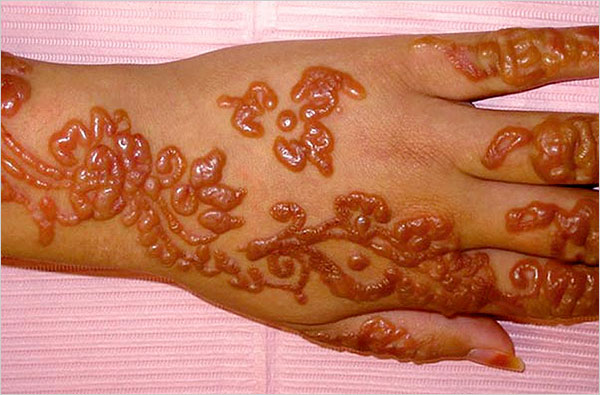
Typical "Black henna" reaction: swelling, itching, blistering, scarring and more.
Where is "black henna" usually found?
- Festivals and fairs
- Theme parks
- Mall kiosks
- Beaches and resorts in Mexico, the southern US states, throughout the Caribbean
- Tourist areas (i.e. south France, Spain, Italy, England, Egypt, Morocco)
- Online through websites
Why even bother with "black henna"?
People have told me they like how it looks like a real tattoo. A safe alternative are Temptu theatrical body paints. These are FDA-approved body paints that have been used on television and in movies to create convincing tattoos. Many colours to choose from, easy to apply and lasts for days.
How can you tell if an artist is using real henna??
- Ask the artist questions! Did they make their own paste? If so, what's in the henna paste? If the artist can't or won't answer your questions, don't let them henna you!Their henna paste should contain:
- henna powder (body-art quality)
- an acidic liquid (such as lemon juice or tea)
- sugar
Essential oil is an optional ingredient - Tea Tree, Lavender, Cajeput, Ravensara and Eucalyptus are considered "safe" essential oils. (Mehndi or Mahalabya oil are unregulated and may contain strong Clove Bud essential oil, ammonia and even kerosene!)
- Look for ICNHA certified henna artists. Artists must take a rigorous test and practical exam to get this certification. This ensures that you are dealing with an educated artist who only uses natural henna. Ask to see their Certificate of Achievement with the ICNHA logo and the artist's name.
- Cross-examine by using this list: Real henna...
- is made from dried, ground-up henna plant leaves... not the roots, bark, twigs or other parts of the plant. Only the leaves contain the dye.
- smells like fresh soil/hay/spinach. It may also smell of the other ingredients: tea/coffee/lemon juice and essential oils (eg. lavender, eucalyptus)
- will only stain skin in oranges, browns, reds and burgundies, in light to dark shades. It does not produce jet black stains or other colours (e.g. blue).
- stains your skin for 1-4 weeks. The longer the paste is left on your skin, the darker the stain will be.
- paste is like mud, sitting on top of your skin. It will flake off as it dries, and just needs to be picked off, not washed off.
- will leave an orange stain on your skin, after the paste is flaked off.
- takes 24-48 hours to completely darken (oxidize).
- benefits your skin; it does not hurt it. Henna has been used for centuries as an antiseptic, astringent, antibacterial, antifungal, antispasmodic (relaxing), antipyretic (cooling), topical sunscreen, antiperspirant, a treatment for sunburn & eczema, in the prevention & masking of foot odour, as a skin moisturizer & conditioner, and as a treatment for alopecia (hair loss).
- will feel very cool on your skin.
- will not leave blisters, open sores or scars on your skin... No matter where location it is applied!
How to report "black henna" use in Canada
Please contact your nearest Health Canada Product Safety Office if you suspect that PPD is being used by a local vendor, or if you suspect you have suffered an adverse reaction from a "black henna" temporary tattoo. Call toll-free 1-866-662-0666 or send an email to cosmetics@hc-sc.gc.ca.
PPD Synonyms
- Paraphenylenediamine (PPD or PPDA)
- Para-aminoaniline (p-aminoaniline)
- 1,4-Benzenediamine
- Orsin™
- 1,4-Penylenediamine
- Ursol™ D
- Rodol™ D
- Paradiaminobenzene (p-diaminobenzene)
Product sensitivities
If sensitivities / allergies form as a result of 'PPD' exposure, here are substances you may also react to:
- PABA-based sunscreens or creams
- Azo or disperse textile dyes
- Sulfa drugs
- Hair dyes
- Black rubber products
- Some "caine" drugs such as benzocaine
- Sulfonamides
- Para-aminosalicylic acid / sodium
- Diaminodiphenylmethane (epoxy hardener)
- Para-aminodiphenylamine (p-amino-diphenylamine)
- Paratoluenediamine (p-toluenediamine)
- 2,4-Diaminoanisole
- Ortho-aminophenol (o-aminophenol)
- Sulfones
Links
- The definitive guide on 'black henna' and PPD (Hennapage)
- FDA findings & warnings on PPD
- The story of young woman (from Toronto) who had a bad reaction to 'black henna' PPD
- Health Canada warning & PPD ban
- "The Dangers of Black Henna Tattoos" on About.com
- Swiss Medical Journal article (PDF)
- PPD & hair dye – did you know that all hairdyes contain PPD?
- PPD allergy report w/ images
- CBC 'Black Henna' report
- 'Black henna' listing in Medical dictionary
- Azo dyes could be banned from skin contact